

I consider myself a conservative, but I’ve come to realise that most people, self-described conservatives included, attach different meanings to the word than I do. This post is a normative definition of conservatism: I explain what conservatives should believe, rather than what people who call themselves conservatives actually do.
I believe in personal responsibility
Conservatism rests on the foundational belief that individuals have agency, and hence accountability. In contrast, some people hold that individuals are powerless in the context of their circumstances, or that societal forces are stacked against them to the extent that attempting to counteract them is futile. This mindset leads them to turn to governments or coordinated action to affect change — for instance, to ban social media for children. In contrast, I hold that people have the power and the responsibility to make their own choices.
As a result, people like me can often be seen as lacking empathy: we are quick to judge and less inclined to make excuses for people. But this isn’t to say we shouldn’t take extenuating circumstances into account. On the contrary, I believe in the old-fashioned, perhaps elitist and even condescending notion of noblesse oblige: people born to privilege have a moral obligation to use their unfair advantages for good (more on this below), and to be kind in their judgement when others don’t live up to their own ethical standards. Still, being kind in judgement does not mean not passing judgement at all. It means doing it in an empowering way: it means telling someone who has erred that it’s within their control to do better in the future, giving them a second chance, and lending them a helping hand when they need it. And while what I describe here can come across as patronising, it’s even more patronising to say that some people have no control over what they do.
I believe that kindness means more than just being nice
I use the word kind many times in the post, so I want to dispel the common misconception that kindness means making other people feel good about themselves.
Sometimes, kindness means the opposite: making people feel bad. This can be when they need to confront an uncomfortable truth, to reflect on their behaviour, to realise they’ve done something wrong; or it can be when they need to stop enjoying something now if it will cause them harm later. True kindness does not mean massaging people’s egos, helping them rationalise away their bad choices, and enabling harmful behaviours. True kindness means being harsh when that is in the other person’s long-term interest. True kindness requires the courage to upset — the difference between it and cruelty is the intention behind it, and the understanding and consideration shown to the other person.
I believe in judging people more by how they act rather than by the theories they espouse
Another pillar of my conception of conservatism is a scepticism towards grand narratives and philosophising. I love intellectual discussions and I have a lot of respect for philosophy, but at the end of the day these pursuits are more likely to lead to sophistry than good behaviour.

and
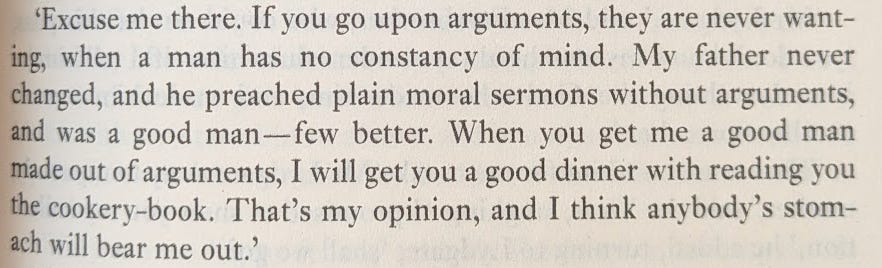
The idea captured by these two passages is that though morality is hard to define and defend on ideological grounds, most people have an intuitive understanding of common decency, of right and wrong. It has always been my strong view that the most common reason for behaving badly in everyday life, and causing harm to ourselves and to other people, is not due to moral disagreements, but due to self-deception. We lie to ourselves about our intentions, we rationalise bad choices, we find reasons to align our ethics to our short-term interests. A person doesn’t shoplift or cheat on their partner because they think they have the moral right to do so; they know it’s wrong, but do it anyway — and then they come up with reasons to justify it. People rarely question their morals out of a desire to be better people: far more often they do it to align them to their interests.
Conservatism tells us to judge people, not on their philosophy, but on how they act: are they kind? Are they generous? Are they forgiving? Are they helpful? Are they fair? Put like this, conservatism sounds uncontroversial, but it isn’t so. It compels us to make allowances, and consider a person fundamentally decent even if their worldview is bigoted: it suggests that such people should be regarded as wrong, not evil.
There are two reasons for this. The first is that few people have such power or influence that the very opinions they hold can do harm at scale, whereas everyday behaviour has an actual, direct impact on dozens if not hundreds of people. What people say, and what people think, has less of an impact than what they do. Words are cheap: there is no virtue in adopting popular moral stances if there is no follow-through. It’s hard to not feel scorn for extinction rebellion participants who eat at Macdonalds, or for actors jumping on #metoo after a life-long friendship with Harvey Weinstein. Conversely, it’s hard being consistently good even on a small scale; we should give credit to those who are.
The second and more important reason is that our collective understanding of what is moral changes over time. I think there is more-or-less objective good and evil, but our ability to tell them apart is imperfect and evolving over time — and not always monotonically either. Dismissing someone as irredeemably evil because their moral philosophy hasn’t caught up with the consensus, in the same way that it is wrong to call a child who is still making mistakes when reading stupid. Consider: many things that were once taboo are now normal, and things that were once normal but are now considered deeply immoral (e.g. homosexuality, slavery respectively). Conversely, who knows how many things that are taboo or normal now will change in the future (incest? meat consumption)? Given that our understanding of morality changes over time, and especially when our judgement of a particular behaviour can reverse (after all, homosexuality was normal in the ancient world), we should be both humble in our confidence on moral truths, and understanding of those who don’t share them. This doesn’t mean we shouldn’t hold moral truths, or that we shouldn’t try to get others to adopt them — of course we should, otherwise there would be no moral progress. But we should do it with understanding.
Meanwhile, although our answers to big philosophical questions are in flux, our shared, instinctive understanding of common decency is more stable. I can deliver a much more confident judgement on whether someone has good intentions, whether they are true to their own ideals, whether they acted out of kindness or spite, than I can analyse their moral philosophy.
I believe in family
Though conservatives are often seen as individualists, and indeed our views on economics support this misconception, we do not consider the individual the fundamental societal unit: rather, it’s the family.
I never cease to be amazed at just how ruggedly individualist most progressive takes on family really are. On both a literal and metaphorical level, the majority of couples keep separate accounts, and evaluate decisions by tallying the costs and benefits to their individual ledgers. ‘We will take turns in our career,’ one couple might say; ‘we will move for my job now, then in three years it’s your turn.’
Instead, my view is that upon marriage (or long-term partnership more generally), there ceases to be a personal account, and there is only a joint one. The question is not whether a particular decision will benefit one party or whether it will harm another, and whether the benefit to one former outweighs the harm to the latter; it is whether the family as a whole is better off or not. Explaining what this looks like in practice is difficult, and in fact, on the face of it the result may be the same as the transactional approach. But the feeling underneath matters a lot: in my view on how a family works, there is no cause for one party to resent sacrifices they’ve made, because those sacrifices were not made for the sake of their partner, but for the sake of the union. There is no room for keeping score or taking turns.
(It is much easier explaining the practical impact of this worldview on money matters: I believe in joint finances. I find it bewildering that the majority of people trust a partner to raise their children, but not to have access to their money.)
I also believe that family members (and friends) have a responsibility to support each other, far more than is the norm in most modern western cultures. I think it has become too common in countries like the UK to demand help from the state — effectively, to ask that strangers subsidise you — rather than to ask parents, children, or siblings for help, both financial and emotional. I know people who would be ashamed to ask a friend for a loan, but who have no compunction demanding higher taxes (on others) to fund (their) benefits; or people who’d never dream opening up about their private life to, say, a parent or a sibling, but who will gladly pay a stranger for therapy. I think this is problematic in two ways. First, it leads to abuse: it’s easier to cheat strangers than relatives and friends. A society where people rely on their network gives people access to the help they need, but also encourages them to get back on their two feet, and not to rely on that help indefinitely. Second, it leads to worse mental health. I think strong friendships and family relationships make people feel better; these relationships are formed and strengthened by placing trust in each other, discussing problems, knowing each others’ histories. Increasingly, people sanitise their relationships by taking their problems to their therapists, which does make their personal relationships more frictionless, but also more hollow. This isn’t to say there isn’t a role for therapy or for a welfare state (more on this later); but that there is a bigger role for family and friends.
I believe in raising children
By which I mean, it is your job as a parent to help your children grow into the kind of adults you want them to be. This includes shaping their character, their values, their manners, and even their tastes; of course, you need to give children leeway to find their own feet, to challenge you, and to be their own people — but their outlook ought to be an evolution over yours, not a radical departure. You should set the direction and let them forge the precise path.
And so, while I believe in having fun with your children, in spending time with them (no holidaying with nannies and childminders; no parking them at resort nurseries), and in showing them respect and engaging with them earnestly, I do not believe in gentle parenting; I do not believe in treating children as your equal. Parents are responsible for their children’s behaviour, and they must set high expectations for them. Parents must demand good behaviour, they must set limits, and they must, when necessary, be strict. As a parent, you must be able to say no.
Finally, parents must hold themselves to account for their children’s failings. Do not blame school, their friends, TV, technology, or any other external factor before reflecting on what you can do better.
I believe in tradition
Instead of relying on a theoretical foundation, conservatism draws on history, culture, tradition, and convention to define ethics. But tradition is not only what defines our values: crucially, it also serves as the medium for passing them on and for preserving culture. If you thought that all you need to do to pass on a virtue is to convince people through argument, you needn’t care for tradition: you’d hand out pamphlets or give lectures, and job done. But if you think that values and a way of life go hand-in-hand, and if you want to pass on your values to your children (which, if you think your values are good, you would), you’ll find yourself very protective of your cultural and family ways of doing things.
This does not mean tradition is sacrosanct and immune to changes. After all, as I acknowledge earlier, many of our inherited moral truths are now considered abhorrent. It is fine to question the morality handed down to us from our ancestors, but this requires a lot of evidence. The risk with abandoning tradition (practiced and tested over long periods of time) of untested theory is that the latter often does more harm than good. Conservatives accept evolution and gradual change; what we should mistrust is revolution.
I believe in decorum and good manners
When it comes to judging behaviour, the most important things are the ones mentioned earlier — the things we usually call virtues. But they aren’t the only things that matter: I believe that the more superficial aspects of behaviour are also worth considering: saying please and thank you, being on time, dressing appropriately, holding doors open, offering to pay, waiting until everyone is served before starting a meal, addressing people in polite form in the languages that support it, being considerate and quiet in public spaces, filling other people’s glasses before your own, standing up to greet someone.
These matter for two reasons. First, they are a sign of respect: contravening a widely-accepted social norm is sending a signal of (almost always) unnecessary rebellion, arrogance, and egocentricity.
(It’s worth keeping in mind though that many of these are culture- and context-dependent. ‘Dressing appropriately’ means different things in different countries and social events, and there are cultures where being late is not considered rude — in fact, the opposite (showing up early can catch the host unprepared). My point is that it’s important to be polite in the context of the culture in which you find yourself. (Though I do think some cultural norms are better than others. Like, why risk miscommunication by inviting people at a particular time, if you want them to show up later? What’s the benefit in that?) (I will also say that given the fragmentation of culture into many distinct subcultures, being polite is becoming increasingly difficult.))
The second reason is that politeness engenders awareness and consideration, and is therefore a prerequisite and an enabler for the more important virtues. Saying thank you requires you to notice when people are being kind to you; holding doors open requires you to be aware of the people walking next to you; as Tom Ford says, dressing well is a form of good manners; and so on. A person who is not aware enough, and who does not care enough to do these things, will soon find themselves not giving up a seat for a pregnant woman on the tube. I think it’s a slippery slope from ceasing to care about trivial manners to being inconsiderate in more important things.
I believe in celebrating excellence
I believe in rewarding merit. We should be doing this both on principle, because excellence is inherently worthwhile, and to be pragmatic: the world is governed by power laws. The top performers in most fields contribute orders of magnitude more than middle performers, and so it’s worth being able to identify and nurture those who have the potential to be great, as they are the ones whose contribution will move society forward.
It may seem like a strawman to suggest that belief in excellence should be a distinguishing characteristic for conservatives: doesn’t everyone celebrate excellence? No. Even besides the absurd, explicit anti-merit views of Woke 1, everyday people do not believe in singling out the excellent in practice: ‘everyone deserves a trophy’ is a real thing. While I strongly dislike it, I do understand it: imagine being a parent and seeing other children recognised as geniuses or great athletes, while yours is left behind looking crestfallen. Recognising excellence entails acknowledging mediocrity, which can be devastating for all of us who are mediocre. But it is a fact that some people are much better at some things than others. Instead of pretending it isn’t so, we should learn to accept it.
It is worth understanding why accepting our own (or our children’s) mediocrity is so difficult, because it is relevant to my conservative philosophy. In my view, excellence is neither the sole nor the most important determinant of moral worth, even though it does have inherent moral worth. The problem is that it is easy to gauge excellence through quantifiable metrics, or at the very least, proxies: we can measure athletic prowess through performance at sports, intelligence through academic achievement, commercial nous through financial success, and contribution to society through fame (granted, more tenuously), and so on; it is harder to measure, and even harder to broadcast, moral worth deriving from other virtues. And so, we focus almost monomaniacally on the things that are easy to track, and we deal with the envy we feel from seeing people do well, not by trying harder, or by learning to be content with our abilities, but by trying to erase or downplay inequality of outcome, even when it is merited.
In other words: some skills or virtues contribute visibly to status. Others rarely do, certainly not publicly: our friends may respect us and value our kindness or courage, but these virtues do not win us medals or other forms of public recognition. In a world dominated by celebrity culture, we learn to care more about status, and to resent those who have it.
We need to fight this urge. We need to learn, and to teach our children, to not only accept that others are sometimes better than us, but to celebrate excellence, and to allow ourselves to be awed and inspired by it.
It is important to recognise that, contra MAGA-style takes, recognising merit requires taking context into account. Excellence shouldn’t be judged solely by the results that someone achieved, but by the obstacles they had to overcome. Conservatives should very much be in favour of (real, not tokenistic) DEI initiatives that aim to help under-privileged people with potential.
I believe in incremental, not radical innovation
I think there is wisdom in systems and processes that have evolved over a long period of time. Things can always be better, but improvements are usually at the margin: if a particular way of doing things were fundamentally broken and unfit for purpose, it would have been abandoned already. As such, when presented with a new idea, I think it’s sensible to ask ‘if this is so great, why has no-one done it before?’ Basically, have some respect for Chesterton’s Fences.
As such, people like me do not make for brilliant innovators or VCs, but that’s fine. Our role in society is twofold: first, to make things work better over time. Not 10x better, but marginally, understanding that even 1% improvements compound over time. Second, to be the skeptics, the ones who challenge easy promises and improbable solutions. Both are valuable services, which ensure that resources are allocated correctly, and not wasted on hare-brained ideas.
This is not to say one should be dogmatic. Radical innovation does happen, and it comes in two flavours. First, there is radical, incremental innovation: the iPhone was markedly superior to all other mobile phones. Then there is disruptive innovation as outlined by Clayton Christensen. Radical incremental innovation is rare, because it’s increasingly difficult to pull off. We’ve plucked most low-hanging fruits; we’re left with the ones at the top of the tree. It takes either unusually bright brains, or immense resources to achieve. Disruptive innovation is easier, but it’s not obvious it will be profitable, certainly not in the short term and certainly not for incumbents. Disruptive innovation is worse than existing solutions in almost every respect, except some niche use case, which makes it appeal to some niche customer segment, and it is not clear that the segment will be profitable, or that the technology will improve from that low base to rival existing solutions in other use cases. And so, when someone claims they’ve found a good, profitable solution that no-one else has thought of, it’s legitimate to consider that claim with suspicion.
I believe companies should care about more than profit
This is a difficult one. At an intellectual level, Milton Friedman was right: companies’ exclusive aim should be to maximise profit. I strongly recommend everyone read his original essay — if you only click one link in this post, let it be this.
Nevertheless, though I cannot answer Friedman with arguments, I cannot help but feel that companies have responsibilities beyond maximising shareholder returns. In particular, I think companies ought to treat employees kindly and fairly, to produce their goods and services as responsibly as possible, and to foster an environment that grows the whole pie rather than their share of it (so, for instance, I don’t think it’s right for companies to lobby for tariffs in their industry).
A cop-out for espousing this so-called stakeholder capitalism is an argument that Friedman himself acknowledges:
Of course, in practice the doctrine of social responsibility is frequently a cloak for actions that are justified on other grounds rather than a reason for those actions.
To illustrate, it may well be in the long‐run interest of a corporation that is a major employer in a small community to devote resources to providing amenities to that community or to improving its government. That may make it easier to attract desirable employes, it may reduce the wage bill or lessen losses from pilferage and sabotage or have other worthwhile effects.
In other words, stakeholder capitalism and long-term profitability are not only not incompatible, but the former often leads to the latter.
But this isn’t really why I believe companies should care about more than the bottom line. As I suggested earlier, I believe there is such a thing as right and wrong that is felt, rather than arrived at through argument, and I believe that people who have privilege also have responsibility, and I therefore think that people who own and run companies ought to do what is right.
Still, there are some complications. First, in today’s world, where share ownership is distributed across thousands of minority shareholders, stakeholder capitalism is less tenable on principle. If I were talking to an old-fashioned industrialist with majority ownership of a firm, I could tell them they, as an individual, ought to behave ethically and selflessly: any corporate decisions they make that cause a reduction in profit affects them personally, and it is the price to pay for doing the right thing. This argument is harder to make when a company is owned by thousands of smaller beneficiaries, and run by a professional manager with little skin in the game: when I urge that manager to put the interests of third parties ahead of their shareholders’, I’m asking them to make a moral judgement (on harming some people so as to benefit others) that they have no authority to make. This doesn’t sit quite right. For the same reason, I am hostile towards activists who aggressively demand that companies prioritise things beyond profit, as though they, the activists, have some moral claim. It seems wrong to me for people to make demands on others.
(Ironically though, modern capitalism makes stakeholder focus more tenable in practice: when everyone owns the entire S&P through their investments and pension funds, the shareholders themselves care more about growing the entire pie, than the success of any single company. And so they have a financial, not only a moral, interest in ensuring individual companies put the interests of wider society ahead of their own.)
Second, the judgement on what is fair treatment is far more complex than it seems. In Europe, we have strict labour laws that are, on the face of it, meant to protect workers. But in my view, these laws are deeply unfair: they make it hard for companies to fire poor performers; but this doesn’t lead to a net increase in jobs, it just means that a company is stuck employing someone who is bad at their job instead of someone who would be good at it. How is that fair to the latter hypothetical employee? More generally, choosing inefficiency for the sake of fairness is doing long-term harm to society — it means less abundance and higher costs in the future; inefficiency means misallocation of resources. So, when I say companies have more responsibilities than profit, I do not mean invariably prioritising things like employee welfare over it; I do mean though that those things has to be an important consideration.
Some thoughts on government
I’ve left this section for last because it’s the weakest part of this post, and of conservative thought in general: conservative philosophy on government is not as clean and absolute as, say, communism or libertarianism.
Conservative philosophy recognises a place for limited government, but in accordance with the aversion to grand narratives, it demurs from overly prescriptive, logically coherent theories. Instead, it takes a pragmatic approach where it evaluates each policy discussion on a case by case basis.
Conservative theory on government springs from the principles discussed:
Belief in personal responsibility suggests individuals should solve their own problems where possible.
Distrust in grand narratives means policy should be pragmatic rather than rooted in philosophy.
Scepticism towards radical innovation means there is an aversion to overly transformative policy.
Deference for tradition leads to an instinct for preservation.
But all these are sort of instinctual positions, rather than logically constructed frameworks.
I believe in small government
Governments have a monopoly on coercive force. This is tremendous power, and should therefore be used sparingly. Not only does government overreach risk oppression and tyranny, but also, because government is slow-moving and hard to overturn, it also risks causing long-lasting bad outcomes. It is easy to turn to government to enforce a policy you think is beneficial; but think how hard it is to overturn bad policies once they’re inscribed into law (triple-lock!).
Given this, we should only rely on government as a last resort. There must be a very compelling reason for government to provide a service (for example, it is an essential service) and the private sector cannot provide it efficiently (due to externalities or natural monopolies). There are very few things that meet these criteria — things like public order & safety (including protection from external threats), a judicial system, a basic welfare net, and preservation (see next section).
Even within these areas, we must be pragmatic as to the level of government intervention. It is hard to come up with iron-clad principles to determine the exact correct level of government action, but we should rely on cost-benefit analyses and common-sense on a case-by-case basis. For example, consumer protection falls under safety — but do we really need to ban ads for tobacco, or to force companies to print horrible pictures on cigarette packs? Doesn’t pretty much everyone know of the link between smoking and cancer by now? Or, exactly how much welfare counts as a basic net? These are hard questions, and they cannot be answered in general — except to say that proponents for more intervention need to make a compelling case on why it is needed: the burden of proof lies with them.
Notice that the belief in small government stems from a distrust in government and the state: this is something on which I find myself disagreeing with other self-proclaimed conservatives. When police shoot and kill someone, most conservatives instinctively align themselves with the police; or, many conservatives believe in the death penalty. I do the opposite: I think the state should use lethal force exceptionally sparingly. My starting position is that a death caused by government is unacceptable, exactly because they are the only ones allowed to kill people, and so it is the state that has to demonstrate why there was literally no other choice.
(Incidentally, this is a fault line in both conservative and progressive thinking, where both camps seem to hold contradictory ideas in their heads. Simplifying a bit, conservatives want small government, but believe in a powerful police state; conversely, progressives want to defund the police, even as they demand more regulation and income redistribution — but who will enforce those regulations and the transfer of wealth, if not people with guns?)
I believe in local government
It’s not surprising to me that two of the most successful countries in the world, the US and Switzerland, have devolved governments. Devolution is not a silver bullet, but it aligns voters’ interests closer with their actions, it allows for faster, nimbler policy-making, and it allows for more natural experiments — different jurisdictions can try different things, and the best ideas will win over time.
However, we must also be clear-sighted on its limitations: devolution can cause suboptimal outcomes if every jurisdiction votes for its own interests but against the interests of the whole country.
I believe in preservation
It is hard not to feel sad when witnessing how Athenians demolished most of their neoclassical gems and how Beijingers razed their hutongs, to replace them with nondescript, grey apartment blocks, or how Greek islands are being converted from quaint destinations to neon-lit, music-blasting tourist traps. As a conservative, I think government has a role to play in preserving both the environment and cultural heritage: I realise this doesn’t quite make the cut as an ‘essential’ service, but I think it’s close enough, and when done right, the cost is low enough, that it is worth it.
But ‘done right’ is doing a lot of heavy lifting here. Despite my deep appreciation for beautiful landscapes and buildings, I am very much a YIMBY — I think most western countries need to build way more housing and infrastructure, and I think construction is over-regulated. As with everything else in this section, there needs to be a balance.
So, what principles do we rely on to find this balance? The first is a common-sense approach to designating something as a listed building or area: such designations should be made on aesthetic value, not historical importance, with very few (if any) exceptions. It is one thing to say a particularly beautiful example of Victorian or Georgian architecture is worth preserving because it is inherently aesthetically valuable. It is a different thing to want to preserve ugly brutalist buildings (n.b.: ‘ugly brutalist’, not ‘ugly, brutalist’) or even any mediocre Victorian example just because they are examples of a period.

(Of course, sometimes, it’s not an individual building that has aesthetic value, but an entire village or neighbourhood. I think it’s possible to designate entire areas as worth preserving, though even there should be some pragmatism and flexibility. Changes that do not detract from the whole effect should be permitted rather than banned on principle.)
The second is taking a holistic approach to development (and this is where devolution can be harmful). It’s fine to restrict planning permissions for mega-hotels in already overcrowded islands like Santorini; but there are many areas in Greece that are far from historically or aesthetically important communities that could be developed. The government could work with the private sector to build infrastructure there (see the success of Costa Navarino).
I do not have a good solution for putting these principles into practice. I do know that most current planning systems, where too many parties have a veto, where the rules for what’s permissible and what is not are purposefully vague (so they’re harder to meet), and where consideration is paid on inconsequential things (like bats), are not fit for purpose.
Conservatism draws on tradition and respects history because they are good guides to the future. They should not be shackles.
Conclusion
Being a conservative requires real sacrifices: first and foremost, the emphasis on personal accountability means one cannot blame external circumstances for one’s failures; the belief in raising children and supporting family members places large demands on one’s time; the respect for tradition means there is less time for new experiences. It is also a particularly challenging philosophy for young people to adopt: it requires resisting fads, moderating enthusiasm in new ideas, discouraging rebellion, being judgemental, upholding social norms, prioritising family and traditions over new friendships and experiences — in short, giving up most hallmarks of youth. Conservatism is, in other words, a restrictive philosophy, in sharp contrast with more individualistic, progressive views that prioritise self-expression and fluidity over rigidity
It is also an unsatisfying philosophy, relying more on practice and intuition rather than clean-cut logic. Indeed, many sections in this post rely more on emotional and ethical appeal — trust me guys! — rather than logical appeal.
Still, it is a philosophy that is worth adopting. Conservatism engenders self-confidence, strong relationships and networks, stability, and a sense of belonging. These are worth its costs.
Re: companies with a lot of owners. Perhaps they are one of many of capitalism's hall of mirrors of responsibility avoidance, and perhaps in those cases, rather than saying 'so much the worse for responsibility', we could say 'so much the worse for the hall of mirrors'."