

I sometimes have something I want to write about, but which doesn’t merit a full post; I’ve collected a few such topics here.
Curiosity
Last year, I participated in a product panel where I was asked to give advice on what young people can do to manage their professional growth in the age of AI. I said they should be curious. The funny thing is that it’s trite, oft-repeated advice, but in fact the cultural and economic structure of modern society tends to stifle curiosity rather than encourage it.
This is probably a good thing in aggregate: I’m not one of those romantics who rail against capitalism because it’s alienating; you can’t create mass wealth in any system that is not alienating. Producing things at scale is complex, and it is impossible for anyone to understand the whole system end-to-end. If we all pursued our curiosity to the full, nothing would get done. Our economy is designed around hyper-specialisation, and in general, this works: you can produce something that someone else uses as input for their work, without knowing anything about their line of business. So even though we praise curiosity, in practice the systems around us discourage it: if students follow their natural curiosity at the expense of their coursework, they will fail their exams. If engineers follow their interests rather than working on their deliverables, they’ll be let go. If academics neglect publishing, or cut corners in the process, they will not advance. Though people around you tell you to be curious, structures tell you to stay in your lane. (Unless you are exceptionally brilliant. The system needs its mavericks, entrepreneurs, and the avant-garde to prevent stagnation. If you are truly great, you can get away with breaking the conventions and processes that keep the whole thing chugging.)
But I think there is room for most of us to be a little more curious than we are, even if we’re not geniuses, without breaking the system. I think this is good for our wellbeing (engaging more with the world around us makes us happier) but also, in times of rapid change, good for our careers. Being curious, well-rounded, and able to learn quickly means we can adapt more easily.
Though curiosity is often thought more of as a character trait than a skill, it is something that can also be developed. I am not always curious, and like most people, I often do things on auto-pilot or take things for granted; but I try to do the following things to flex my curiosity muscles:
Notice when I’m not being curious: every now and then, I ask myself whether I really understand something I think I know. Usually the answer is no: think of everyday concepts to which we refer, or things we use, and ask whether you can define them or explain them. What does ‘time’ mean? How is wine made?
Ask why things are done in a particular way. For example, why is it so rare to see french shutters in London, even though Paris (which has quite similar climate) is full of them? (Two big reasons apparently: first, though the climate is similar, London is much windier. But second, after the Great Fire of London, Parliament passed an act that required window frames to be recessed within brick walls, which makes attaching french shutters harder. The act has been repealed, but the practice persists, since new buildings generally have to fit in with the aesthetic of other buildings in the area.)
Name things: I realised recently that I don’t know the names for many, many things I see around me. For example: the decorative lines on furniture (fluting); the different types (orders) of columns; the kind of column that’s built into a wall, rather than be freestanding (pilaster); etc. Or I accept the name we give to something without really understanding it (e.g. what’s the difference between realism and naturalism? What’s a fish? (Most everyday markers of fish (e.g. scales and gills) are both not unique to fish, nor are they found in all fish.))
Keep a notebook where you jot down things you learn: my wife and I got into the habit of doing this, though I’ve dropped it recently. It’s a good practice though!
Assume something is possible: when solving a problem, it helps to start by assuming it is solvable. This is something Elon Musk is really good at — his principle is that something is feasible as long as it’s not prohibited by physics. This unlocks curiosity, because it forces you to think, if this is solvable, what are the steps to solve it? I know this sounds so obvious it’s not worth saying, but it really is a big mindset shift. Linked to this, one thing I’ve noticed is that many people ask how to do something without even trying to find out themselves — let me google that for you is a thing for a reason. In principle, there’s no reason why asking a human how to do something, rather than asking google, is an indication of lack of curiosity, but in my experience it absolutely is: people who ask google, who try to find things out for themselves, seem to be more curious and better at picking up new skills.
Sophistication
A common alleged marker of sophistication is jadedness and cynicism. If you want to appear cool, cosmopolitan, worldly, you are told you have to not appear too eager, earnest, or excited.
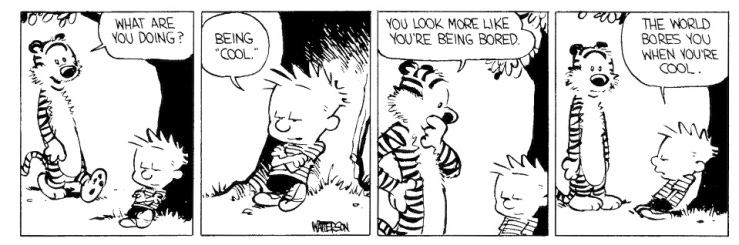
No matter what you do, you should look like you’ve been there, done that before. If you show too much excitement at climbing aboard a yacht or private plane, or tasting a Michelin meal or a good Bordeaux vintage, or visiting Annabel’s, or buying your first Rolex, you’re signalling that you’re new-money, gauche, a hick. In fact, you’re parochial for making these references in the first place. Everyone knows that Burgundy’s where it’s at, that only wannabes go to Annabel’s, and that no-one with taste would ever be seen wearing a Rolex. And God help you if you put effort into anything. You should definitely be good at things, but it must be effortless. Trying too hard isn’t chic. It’s not aristocratic.
Well. I’m here to tell you this advice is categorically wrong, both descriptively and prescriptively. On the descriptive side, if we use proxies such as class, education, and travel for sophistication, most advice you’ve read about how to appear more educated, upper-class, or well-traveled than you are is useless (and this includes the statements above). It’s not that these groups don’t have distinguishing characteristics, but a) as Nancy Mitford has written, most advice on how to be U is decidedly non-U, and b) joylessness and lack of excitement is not one of those distinguishing characteristics. In fact, the most U thing you can do is not care whether or not you appear U. Suppressing exuberance for the sake of appearing sophisticated is the least sophisticated thing you could do.
As for the advice being prescriptive, why would you ever heed advice that tries to stamp out your joie de vivre and your effort to better yourself? What’s the point in being cool if being cool means you can’t have fun?

Ignore the naysayers. Do your thing.
Grade inflation & cash-cow degrees
We all know grade inflation is a thing. Almost 30% of students achieve a First, about twice as many as in 2011 (though it’s come down a little recently), and almost everyone gets at least a 2:1.
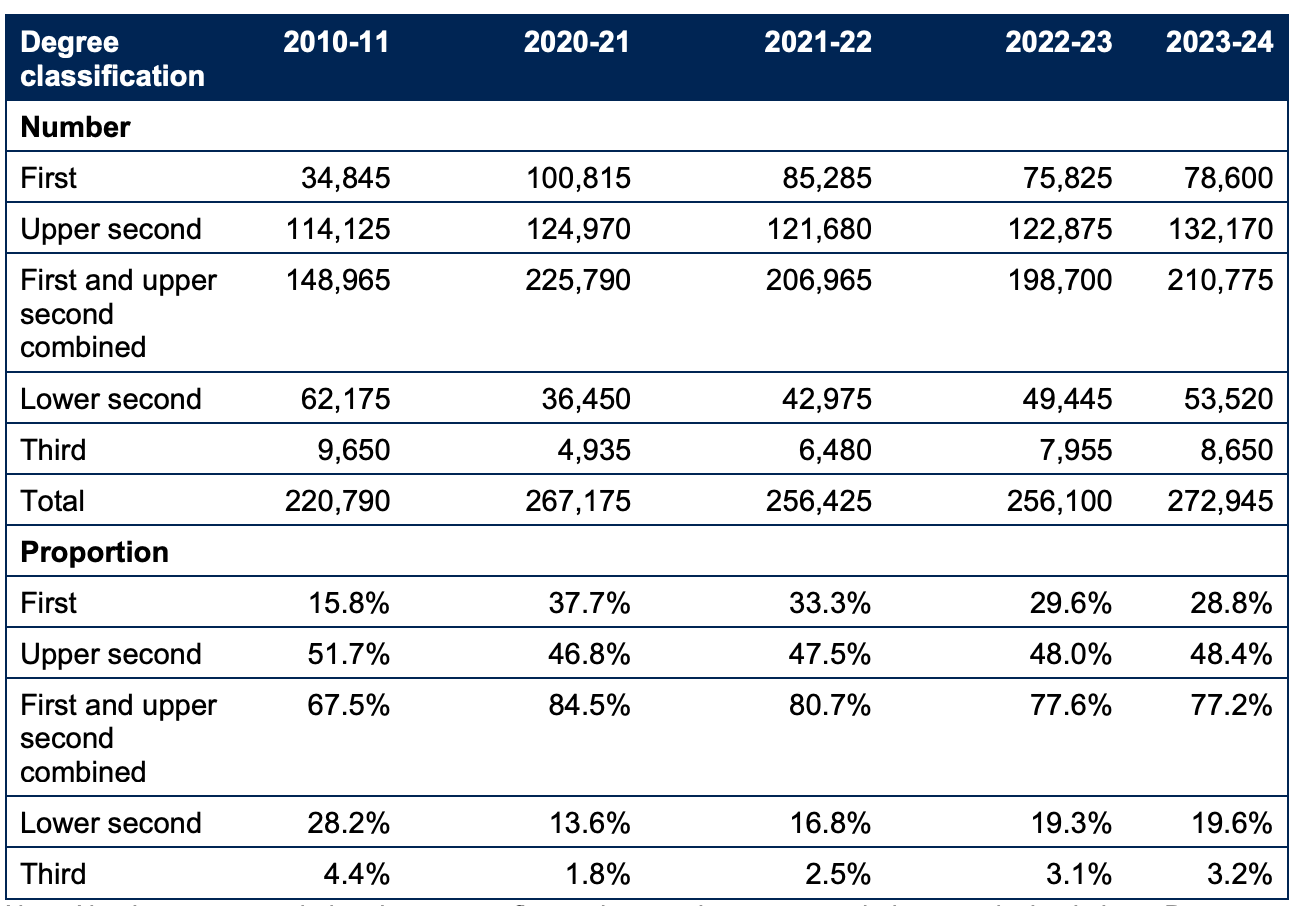
In addition, what I call ‘and’ degrees (computer science and management; economics and business) and other cash-cow degrees have proliferated. These are degrees offered even by prestigious universities to generate income, but whose curricula are less rigorous than their standard courses (PPE - Politics, Philosophy, and Economics is the outlier here: it’s still a prestigious degree, despite the performance of its recipients in recent years).
There are many problems with these trends that others have analysed in depth, but the most obvious one, and the one I’ve noticed personally, is that the signalling value of a degree, even at a top university, has collapsed. I regularly interview graduates from the UK’s top universities, all of whom have at least 2:1s, many of whom have firsts, and most of whom even have masters, often with distinctions. Yet many fail to answer relatively basic questions (I asked for an example of innovative problem solving, and a candidate said they used their phone to translate from Spanish to English when they were on vacation).
Unlike many grumbling millennials, I don’t think there’s an actual deterioration in the quality of graduates, but I think it has become much harder to spot the good ones. This is bad for everyone. It’s bad for employers, who must invest much more effort in screening, but it’s also harmful for students. Since they can’t rely on grades alone to secure a job, students must now fill their CVs with spring work placements, summer internships, leadership (not mere participation) in multiple student societies, and other extra-curricular activities. Not only does this suck up time, but it’s also soul-destroying: I’m sure students know, deep-down, how superficial their engagement with the myriads of activities they undertake to pad their resumes really is. When I was at uni, I could focus on my studies, on participating in a couple of activities that I really enjoyed, and on courting my wife. My CV would never make it past the screening stage these days.
Also, most companies are not very good at screening candidates, and so students secure jobs for which they’re not actually qualified. Again, this is really bad: employers have to invest significant time and effort managing them out, and, needless to say, this process is pretty crushing for recent graduates. It is better not to get a job you can’t do (and which you will not enjoy), than to get it and be fired.
I don’t really have a conclusion to this. It’s just a sad state of affairs. All I can say is, if you’re an academic, stop making excuses and start grading students fairly.