

Social media bans exemplify my notion of bad policy: they are populist, they are not backed by data, and worst of all they are immoral and damaging because they erode people’s sense of personal responsibility.
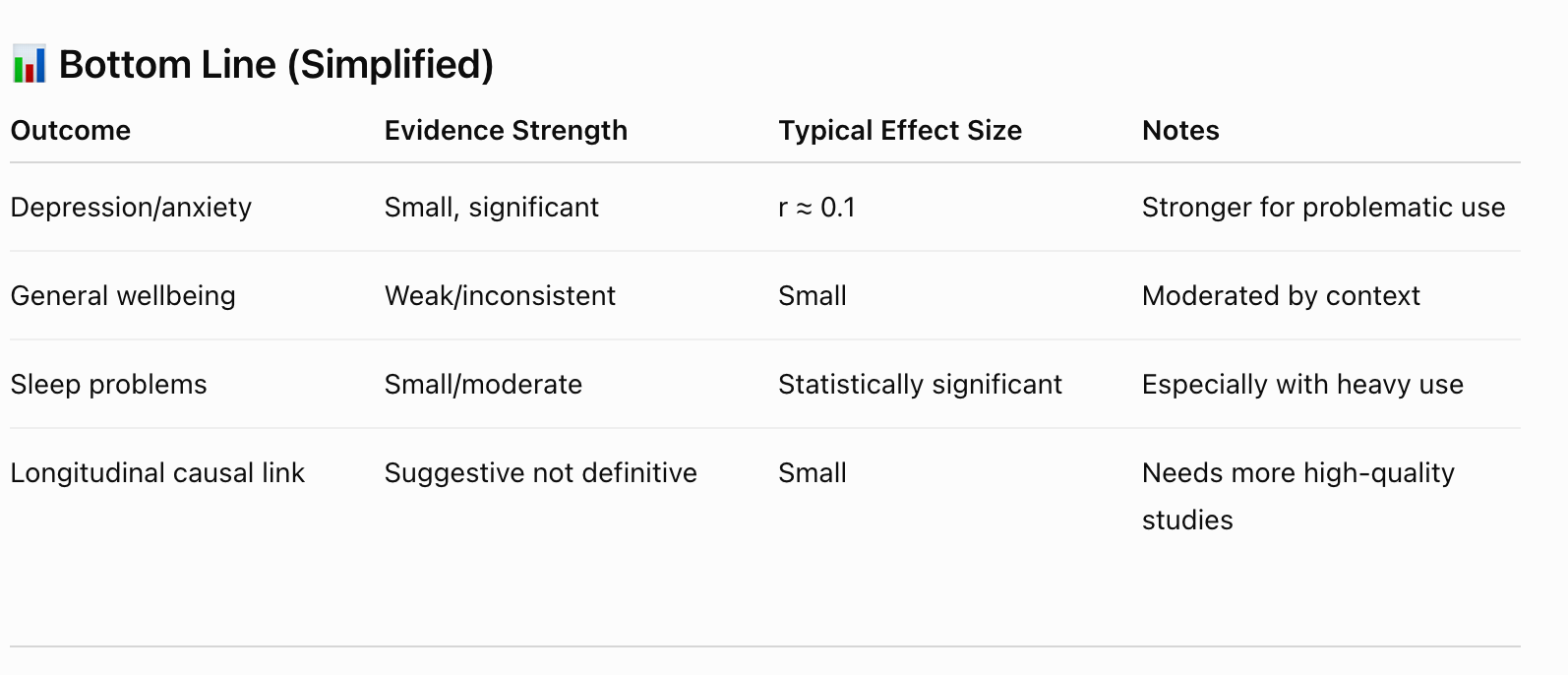
I am against social media bans for three reasons. The first is the traditional classic liberal argument is that in general, we shouldn’t be banning things unless they really are causing serious harm. I know most people have an instinctive dislike of kids using social media, and I know many are convinced that social media use leads to irreparable harm, even death, but the data does not support this. Here are GPT’s, Gemini’s, and Claude’s summaries of studies on the impact of social media on children, which are pretty much unanimous: most studies do find a statistically significant correlation between social media use and negative mental health outcomes, but the magnitude of the impact is small, and there is ongoing debate on whether the link between the two is causal.
I know it’s customary to point to charts showing mental health deterioration among teenagers, and to attribute that to social media:
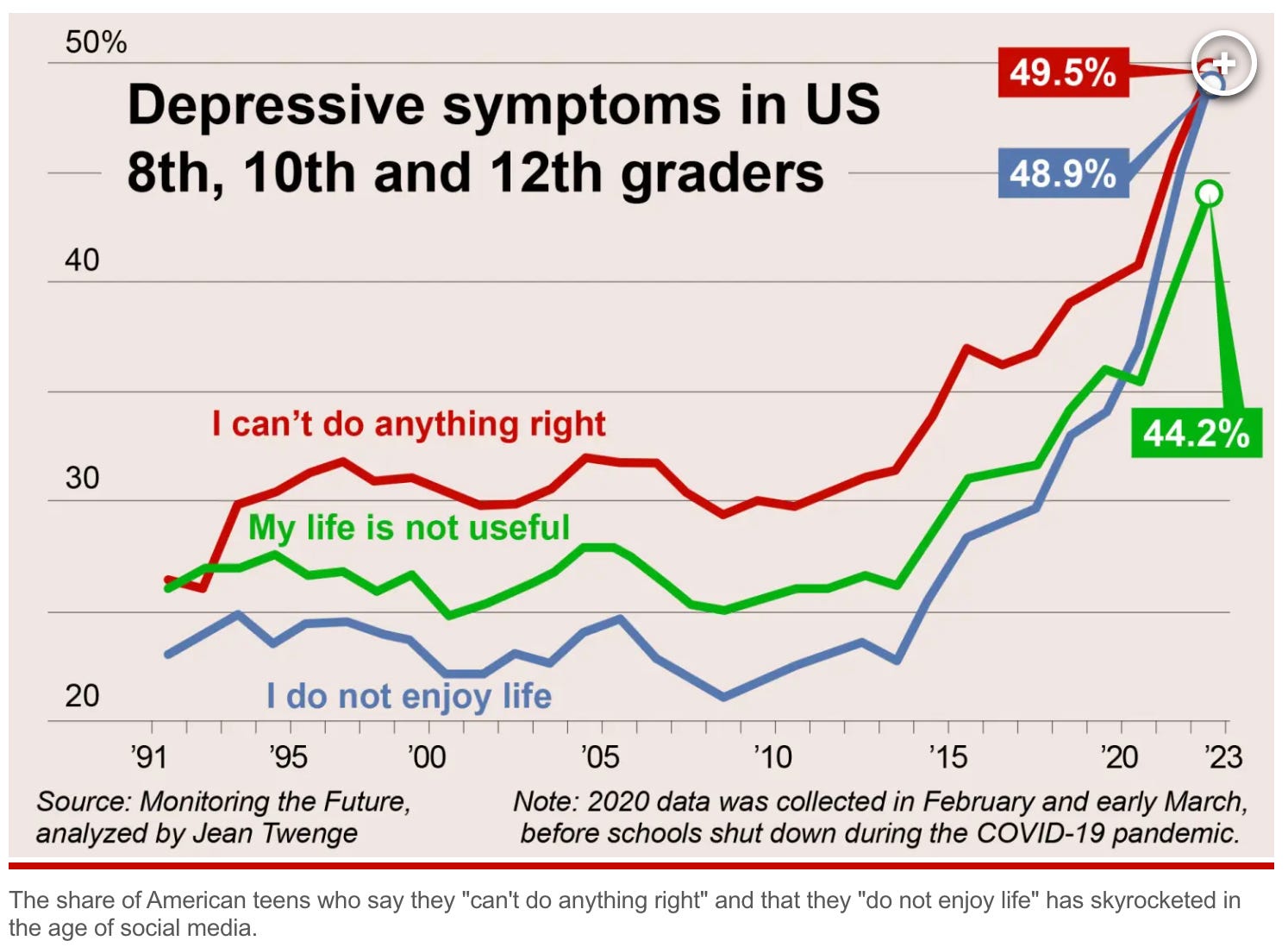
But this attribution is too glib. Many other factors could explain this rise: there is ever-increasing academic pressure and higher economic insecurity; there is technology more generally, rather than social media specifically, which in turns means children are spending less time outside or socialising in person with their friends; there is safetyism, with more parents never letting their kids out of their sight — we complain that our children are cooped up inside, but what else can they do if we don’t let them go out?; and there is less stigma attached to mental health (which is good), as well as increasing pathologisation of normal feelings (which is bad), leading to more reports of poor mental health. My view is that of these, the largest factor is technology and short-form content in general. You might think I’m splitting hairs, but the distinction is worth making as I’ll explain further on.
(By the by, as Eli Stark-Elster points out, school has a far, far worse impact on children than social media: suicide rate among children is up to 25% lower during summer months, when school is out, than it is the rest of the year; children themselves say that school is pretty much the most stressful thing in their lives, with 88% attributing stress to academic pressure, and only 28% to social pressures. So, improving the school experience would do far more for children’s welfare than banning them from opening YouTube accounts.)
The second argument against the ban is that social media can be good for children. My son has been creating stop-motion videos with his cousin since he was five; I have no objection whatsoever to his creating a YouTube account to upload them and share them with the world, and I find it insulting that my choice as a parent gets arbitrarily overridden by the state. If my daughter gets into coding when she’s 12, why shouldn’t she be able to discuss her projects on Reddit, or find collaborators online? If my children decide they want to write reviews on Goodreads or Substack, why should they not be allowed to do so until they are 16? Like everything else, social media are tools that can be used well, or can be used badly; and like everything else, most people use them badly, that’s true, but the benefits of good use far outweigh the harms of bad use. Good use of social media can give us our future poets, authors, journalists, film-makers, engineers, founders, scientists. Taking this away from children is doing us all a disservice.
But the third and main reason I object so strongly to the bans is moral. Plutarch wrote over 2,000 years ago that
the politician, after gaining power and trust, must then attempt to train the character of the citizens.
Which is to say, politicians ought to aim to make better citizens, if not better people, out of their voters. One of the most important aspects of bettering your character is to assume personal (in this case parental) responsibility.
I get why people want to steer children away from social media, even if they do have positive impacts. But if your child spends more time on their phone than talking to you, or playing outside, why not start by asking whether there’s anything you can do differently instead of asking the government to step in? And do you think that governement intervention would magically fix things? It’d turn your child to an eager reader? They’d suddenly start going out with their friends? They’d join you for dinner and make good conversation with you?
More likely, they’d switch to something else to do on their phone. Play Candycrush or watch Netflix, or whatever it is teenagers do now. The problem isn’t that your kids are addicted to social media, it is that you did not teach them to do and enjoy other things. You could have chosen not to give your children a tablet and unrestricted screen time before they could crawl. You could have chosen to enforce parental controls. You could have spent more time doing activities with them. You could have played board games with them. You could have taught them to appreciate nature. You could have taken them to museums and galleries.
If you didn’t do these things, if you’re still not doing them, that’s on you. If you turn to the government to fix what you think is the cause of your child’s unhappiness, you will never confront your own mistakes, and you will therefore not address the true underlying causes of children’s unhappiness.
In other words: you, the parent, are responsible for raising your child. Own that accountability. Don’t delegate it to the government.
Now, I know, you have several objections to my argument. Let’s go through them:
I do all the things you mention above, and my kids still want their tablets and TikTok
Yes, this will happen! Even if you do everything right, your kids will still face peer pressure, and even if they grew up reading books, they’ll still be drawn to short-form content. Most adults I know get addicted to doomscrolling, regardless of how well-adjusted they are. I lose myself doomscrolling.
But again, it’s your responsibility as a parent to stand firm: insist on good habits, enforce simple rules such as no phones at school, the dinner table, when watching a film together, or before bed. This really isn’t hard, especially if you’ve been enforcing these rules from a young age, which most people don’t.
It’s a coordination problem! I can’t unilaterally stop my child from using social media if all their friends are on them
You can unilaterally stop your child from using social media. You’d have to weigh whether the harms from social media use are higher or lower than the harm from social exclusion, and if you think they’re higher, you’ll have to accept the trade-off.
But you don’t have to cut off social media entirely anyway! You can just teach your children to use them responsibly, and to not be glued to their phones, which is after all a better outcome: bans are always crude tools. Teaching responsibility, moderation, and resilience are better. And this is why the distinction on whether it’s technology in general vs social media in particular that’s the cause of malaise is important: if it is technology rather than social media, there is less reason to enforce an absolute ban on the latter, and to focus on simply reducing screen time, which is much easier and doesn’t come with social exclusion.
Besides, a ban would actually magnify social exclusion effects in two ways: first, what you’ll end up with is that the children who are more likely to follow rules will be excluded by the children who will find ways around the ban. Second, you’re punishing the kids who are facing exclusion already, and who find refuge in online communities.
Check your privilege — easy for you to moderate your kids’ use of technology, it’s much harder for [a single mother / someone on benefits / insert other underprivileged group]
Even overlooking the snobbery of suggesting that lack of privilege results in bad parenting, middle class professionals support the social media bans just as much if not more than everyone else. It’s not lack of privilege that is making parents make bad choices when it comes to technology.
There is no better proof on this than observing families during flights or train journeys. This is time where you, the parent, have nothing else to do: you can choose to see it as constructive one-on-one time with your children. You can read books together, draw, talk, write stories, play. Yet what do 99% of parents do? They give a tablet to their child before the plane even takes off. And why? So they can turn to their own tablet instead.
Now tell me, how can you defend that? The vast majority of parents choose to get their kids addicted to screens from the age of one, even when they themselves have nothing else to do, just because it’s convenient. Think for a moment what this is saying: parents prefer to spend 3 hours looking at a screen themselves, rather than interacting with their child.
So, as long as parents are choosing to get kids addicted to technology to avoid interacting with them, I think we should blame them for any subsequent malaise, and not TikTok.
Even if we accept social media (and more generally, screen) addiction is the parents’ fault, we expect the government to intervene when parents make bad choices. We don’t let parents give alcohol or tobacco to children, for instance.
Actually we do, at least in the UK. Parents are allowed to give alcohol to children in their home from age 5. Still, I accept there are cases where we let the government step in if parents are negligent. However, there are three distinctions worth noting: first, there’s the question of magnitude discussed earlier. Smoking causes cancer; alcohol can cause poisoning; social media causes a barely perceptible negative impact on some proxy metrics for mental health.
Second, it’s much easier for a parent to restrict social media use than substance intake — and when I say ‘easy’ I don’t mean in the psychological sense but the purely logistical one: if it were legal for a child to consume alcohol, a parent wouldn’t be able to prevent their child from drinking if the child wanted to. They’d just do it every time they’re out with their friends. Whereas with social media, it’s easy to limit use — if nothing else, at least while the child is in the house.
Third, and most crucial, in cases other than social media, we hold parents accountable for their bad choices. If you boarded a flight and saw a parent handing a tumbler of whisky to their two year old, you’d intervene. But you don’t blink an eye when you see a parent handing over a tablet — yet you are prepared to draw an analogy between the two to justify a social media ban.
A parent that got their child addicted to drugs, or who got them habitually drunk, would lose custody pretty quickly, and they’d be told they’re a bad parent. With the social media ban, we’re absolving parents from all responsibility.
The bottom line is we are too quick and increasingly willing to grant lack of agency in our society. We have developed a very bad habit, especially in Europe: whenever something goes wrong, instead of thinking of what we can do about it, we ask what our governments should do. This, by the way, betrays a dreadful lack of curiosity: we don’t stop to question why things are not as we’d like them, we don’t try to understand the underlying causes, and we certainly don’t make any effort to address them.
The consequences of this habit are dire. If we tell people they are powerless over something, and if this helps them convince themselves that when things go wrong it’s through no fault of their own, they will believe us — they will want to believe us. And things will become still worse for them, because next time something breaks, instead of confronting the problem, they will disclaim agency over it as well.
Interesting piece, but I strongly disagree with it. You say ‘we do pass laws that force certain behaviours in order to solve coordination problems’ - but this is exactly the situation faced here: a collective action problem. And on the ‘no evidence’ point, if you’ve not read The Anxious Generation, I’d really suggest you do so - there’s a decent weight of evidence to support the concerns. I’ve written up my thoughts here in case of interest: https://tmbtp.substack.com/p/banning-social-media
I'm personally pretty on the fence about social media bans for kids. The ID verification checks is about the biggest issue for me. But this article doesn't do much to convince me on the ideological side of things. I'm not the most liberterian person around. Do you have similar opinions on banning pornography, or drugs, for children? Do you have opinions on governments doing things to improve public health? It seems to me that social media bans for children fall into similar spheres as some of those things.