

I’ve been thinking on a good book-rating mechanism for Bertie. The problem with star or number ratings is that everyone uses them differently, and so they impart little information.
One idea I had is to introduce a 4-option text rating:
Essential: a book everyone has to read at least once in their life.
Standout: a great book within its genre, worth reading for fans of the category.
OK: a decent time-filler, but nothing remarkable.
Skip: you regret spending time with this book. Not only do you not recommend it, you actively recommend people don’t ready it.
While thinking about this, I went through my bookshelves and picked the books I’d rate as essential. I’m not going to list them here, but I do want to share some thoughts that occurred to me while doing so.
All ratings systems are reductive
I mean, obviously. Assigning a label or a number of stars to a work of art is too crude, and misses out on a lot of nuance. That’s why reading book reviews (even rapid-fire ones!) is a better way of choosing what to read.
In particular, it’s hard to assign a rating in (at least) the following cases:
There are books that can be deeply moving if you read them when you’re young, but whose impact is dulled when read by an adult.
You might have a deeply personal reason for loving a book: perhaps you read it at a particularly important or memorable time in your life, or it was a present, or it was written by someone you know and care about.
A book may be a poor execution of a great idea, or
It’s an unfinished novel, such as The Last Tycoon.
Sometimes, an author’s work can be Essential or Standout, but it can be hard to pick one book among their output. For example, I think that reading Agatha Christie or P.G. Wodehouse is essential, but I’d be hard-pressed to pick one of their books as the single must-read.
So why bother introducing ratings to Bertie? Well, first, I’m not yet sure I’ll do it. But if I do, it’s because a lot of people see value in them: we’re all looking for ways to cut through noise and find things to read, and we don’t always have the time to read reviews. Looking at how people we’ve trust have rated books may be flawed, but good enough.
(In the spirit of good enough, I also built this over a weekend: a web app that lets users rank books using ELO — have a go! Current top ten:
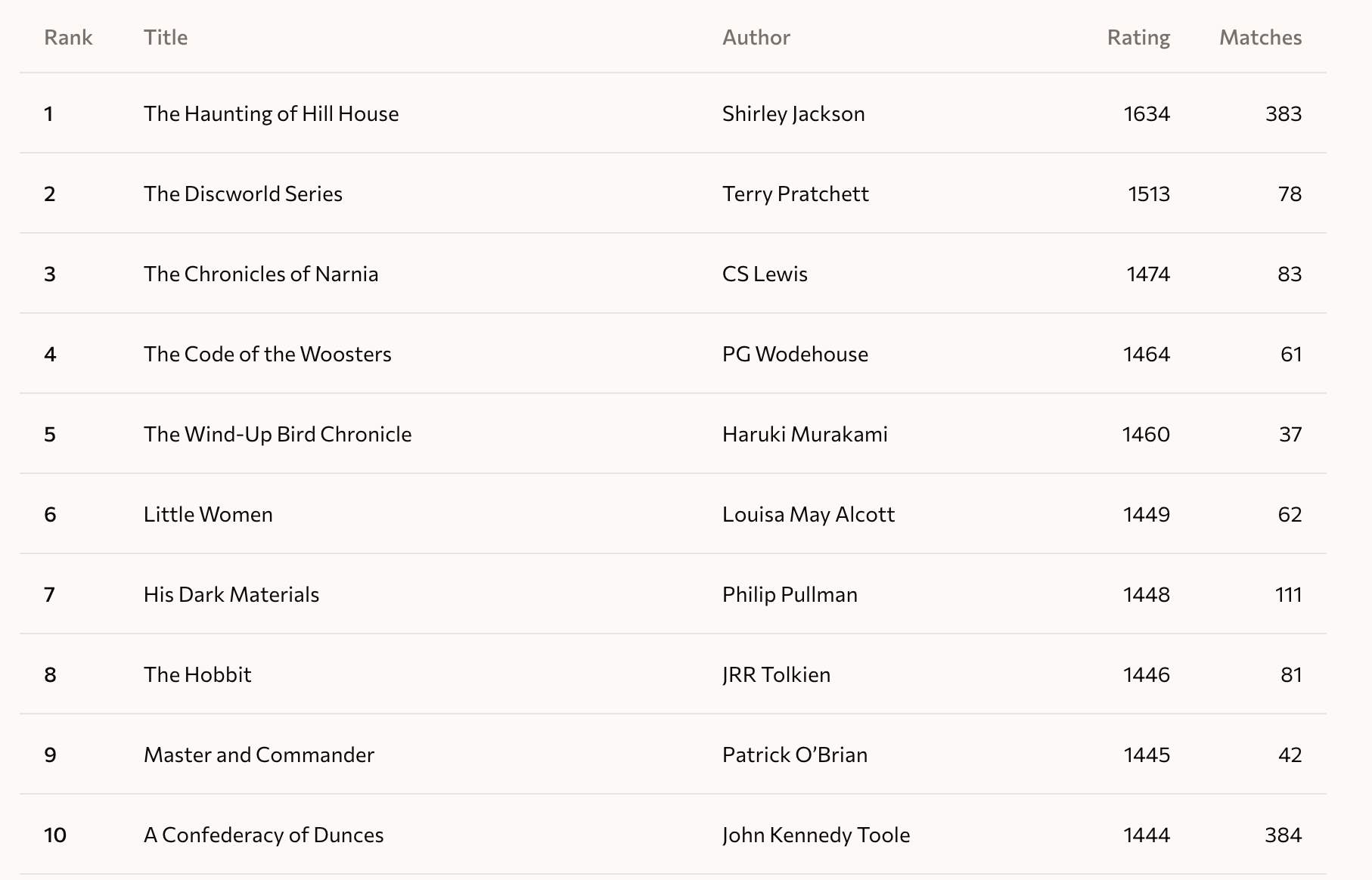
)
Books as cultural artefacts
Most of the books I’d list as essential do not earn this rank because of their quality, but because they are engrained in our cultural psyche. They come up in conversation and in other works of art, so knowing them makes it easier to appreciate other things our society has to offer.
In fact, some books are essential solely because of the fact they’re part of the canon. An endless number of classics scholars will try to tell you that reading the Iliad is just as relevant today as it was 3,000 years ago, but quite honestly, it’s not. It’s page after page of descriptions of battle, and though some of its themes still interest us today, the cultural context of the times was too different from ours: understanding how classical-era Greeks thought about honour or heroism is a stimulating exercise, but has little bearing on how one should think about the world today.
Similarly, there are many other novels that I’d call essential because of how often they are referenced. If you were hard-pressed to only list either Pride and Prejudice or Vanity Fair as essential reading, which would you pick? Both are great novels, and in fact, many would argue Vanity Fair is more incisive. But I think most would agree that if you could only read one, it should be Pride and Prejudice, not because it’s better, but because it is more often referenced in common discourse.
Or consider, e.g., Atlas Shrugged and Fountainhead. I think the latter is a much better book, but the former has been much more influential, and would therefore rank higher in most must-read lists.
Bad but good
Most of the books I’d list as Essential because of their cultural importance really are great. But it is worth thinking about books that are terrible yet interesting in their terribleness.
On one hand, reading a book that’s badly written and that’s not edifying is a waste of time. On the other, there is something fascinating about such works. For instance, the gratuitous writing style, and the black-and-white, hard-boiled morality in Mickey Spillane’s novels is very compelling. But they’re so crass, and so obviously bad, that I’d be embarrassed to recommend them to anyone to read without a bunch of caveats and qualifications.
And what about books that are interesting in a meta sense, in the sense that the only thing really interesting about them is trying to understand why they’ve become best sellers? Are they essential? Certainly not on their own; but as a means of understanding contemporary culture, they are a useful tool (I’m thinking of the likes of 50 Shades of Grey or Milk & Honey).
So I haven’t quite concluded on how I’d rate such books.
Idiosyncrasy
There are a few books that I’d call Essential because their writing is so unique. I’m thinking of works by the aforementioned P.G. Wodehouse and Agatha Christie, as well as those of David Foster Wallace, Milan Kundera, Franz Kafka, Tom Wolfe, or Vladimir Nabokov.
Their novels stand apart not because they present better ideas in a better way than other novels, but because of their unusual writing styles or constructions. Reading these books does not necessarily help us understand human psychology better, or ponder philosophical themes, but it helps us understand and appreciate language, humour, and the act of reading itself.
Books are not life-changing
There are several books I’d list as essential because they’ve been seminal: they have influenced my thinking, have helped shape my mental models, or have taught me to appreciate prose.
But none have been life-changing: it’s not like my life was headed one way, I read a book, and suddenly changed course. I doubt this ever happens, despite the number of books hailed as ‘life-changing’.
And if it does happen, it’s much more likely that, due to a random confluence of factors, a person is unusually receptive to a particular message, and they happen to read a book that conveys that message well. For example, a teenager is considering what to study at uni, they come across The Undercover Economist, they fall in love with economics and decide to become an economist. This doesn’t mean that the Undercover Economist has a life-changing quality, not any more than other pop-econ books do.
Anyways. These were just some random thoughts — would love to hear alternative ideas on classifying books, or to read people’s Essential recommendations!