
Even more thoughts on paternity
Pick your battles; Is Santa real?; kids these days; difficulty curves

Pick your battles
I’m very bad at picking my battles with my kids: sometimes we get into arguments over really stupid things, which start with a disagreement over something inconsequential (for instance: should my almost five year old daughter be allowed to use a baby cup?) and escalate into full-blown tantrums. My wife is very good at avoiding this: if something doesn’t really matter, why fight over it? Be more like my wife.
However, when you do pick a battle, make sure you win it. I see many parents who let their children grind them down through sheer obstinacy. It’s one thing if your children convince you they’re right about something: when they do that, you should absolutely give in, and congratulate them, and make a point of how important it is to change one’s mind without shame when one’s been proven wrong.
(I had assumed it would be years before my children would win an argument over facts, but I was dead wrong. An early example was when my son aged three or four pointed to a coat peg in his nursery and said ‘that’s Manu’s peg’. Over the peg was the name ‘Louis’. So I kept telling him he’s wrong, look, it’s Louis’s peg, and he kept insisting, and it turned out his friend’s name was Louis Emanuel, but went by Manu. In my defence, Manu’s school also got mixed up over this, and Manu’s mum received a call two weeks in asking her why her son hasn’t been attending school since the start of term (I like to think that they also spent two weeks looking for the mother of that unregistered kid Manu who showed up instead of Louis)).
But you shouldn’t let a child get their way just because they’re good at throwing a tantrum or ignoring you. I see so many children at the playground whose parents are having a hell of a time taking them home: they (the parents) will say ‘it’s time to go’ and the child will say ‘can we stay a bit more’ and the parents will say ‘no’ and they’ll end up staying another hour. This undermines your authority as a parent, and if your children don’t listen to you over trivial things, they will learn to ignore you even when it matters. If you don’t need to be home, then say ‘yes’ in the first place, and stay longer; but if you have things to do, and you really must go, then set a timer on your phone and when it rings, go home (timers work really, really well. It’s much better to give a five minute warning than to suddenly tell them it’s time to leave with no warning).
The Santa Question
My wife said that the conversation on Santa Claus is the only situation we’ve encountered as parents where she’s not been sure what is the right thing to do.
The thing is, belief in magic and the supernatural is a good feeling: it’s comforting (arbitrary (unfounded) belief in a morally coherent magical system is more reassuring than reasoned belief that there is no higher moral authority), and it inspires a sense of wonder (those drawn to science feel a sense of wonder stemming from the discovery of the laws of nature; but this isn’t a universal feeling).
We grown ups can choose our path: when we encounter a new phenomenon, some of us will try to interpret it through reason, whereas others will be drawn to mysticism (aliens! time travellers! Atlanteans!). But children don’t have the same choice — their parents need to make it for them. And in the case of Santa, unless the parents themselves truly believe that a jolly man in red delivers presents to their children, it is impossible to preserve the illusion and be honest.
We did attempt to do both. Up until this year, we never explicitly told our kids that Santa physically delivers presents. We talked about Santa’s real-life origins (St. Nicholas in Northern Europe and St. Basil in Orthodox traditions (the two were near-contemporaries, who both lived in what is now Turkey)), and we told them that ‘it is said Santa Claus brings presents’ (the wonders of the passive voice! No wonder it’s the chosen tool of politicians and equivocators).
But last Christmas, our son asked my wife point-blank whether Santa is real, or whether it’s she who fills in their stockings. My wife asked him, — what would it take for you to believe in him? — Proof. — What counts as proof? — If you tell me he’s real.
So my wife told him that it’s she who fills in the stockings. But this doesn’t mean Santa isn’t real in a different sense: there were real people who inspired the myth, and the myth itself inspires us to make Christmas special; and sometimes, pretending to believe in something is almost as magical as actually believing in it — so next year, our son can choose whether he still wants to write a letter to Santa, prepare the stockings, and leave a cookie and a glass of milk out.
Kids these days
It’s such a cliche to speak of ‘kids these days’ and how ill-mannered they are. And to read about knife crime and gangs and violence, or (not quite as bad) how even college students are almost illiterate. But my own experience is very far removed from all that: almost all children at my kids’ school are sweet, kind, friendly, and into reading. I’ve not seen any signs of bullying. And no, this isn’t at some elitist private school: it’s a state school where 1/3 of kids do not have English as a first language, >60% of them are eligible for free meals (vs 25% average for the UK), and 22% require additional support (vs 14% average). I am not sure how to explain the disconnect between what I see, and what everyone else is taking about (e.g. re Adolescence).
Interestingly, children in Greece seem much meaner. We went to the playground near my parents’ house in Athens, where my children, and those of some friends of ours, started playing with local kids. Our children shared their toys with their new companions, but the latter not only did not reciprocate, they hit our kids and blocked them from using playground equipment.
(Also, sexism: one boy stood in front of the slide and told my daughter ‘no girls allowed!’. She was flabbergasted, she had never come across this in the UK. (The children in my son’s class do self-segregate, but from what I gather, if a girl wants to play with the boys she’s welcome, and vice-versa.))
I see this looking back at my own childhood. Though I don’t think there were many bad cases of bullying at my school, but there was certainly a streak of meanness that I don’t see among my son’s classmates. I remember once a friend of mine wore shorts with a sort of tassel-like embellishment at school: he was mocked all day. More generally, if you did anything that stood out a bit, people would notice and their first reaction would be to make fun of it.
What explains this difference? It could be class — with upper classes being more likely to bully (I went to a private school, and the playground we were at where we encountered the mean kids is in an expensive suburb of Athens.) British boarding schools are (or at least were) notorious for their bullying culture. Is it that conformity is more valuable for upper classes, because they only stand to lose from any kind of change? Then again, my dad, who went to a boarding school Switzerland, says there was no bullying there.
Difficulty curves
We often speak of learning curves, which (I think?) show amount learnt over time: a steep learning curve is one where you have to learn a lot very quickly just to get a grasp of a concept, with much smaller improvements later on. I think a better way to show this is the difficulty involved in learning something.
What I’ve found with children is that doing anything with them — from getting them into reading to teaching them how to ski — has this difficulty curve:
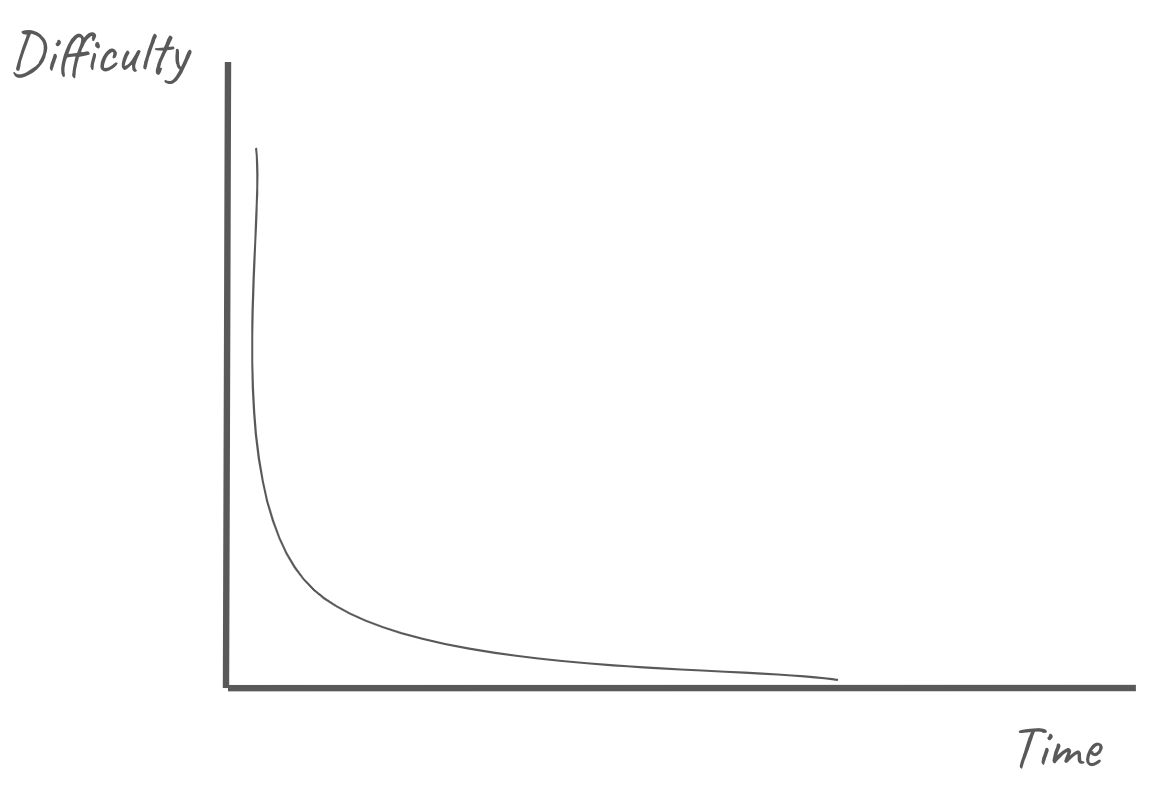
At the beginning, teaching any skill to a child is frustratingly hard, and feels almost impossible. But after a short while, everything becomes so much easier. I’ve been teaching my daughter how to ski this holiday. The first day I couldn’t get her to break, or to turn — I’d put her on skis, and she’d go straight down and crash.
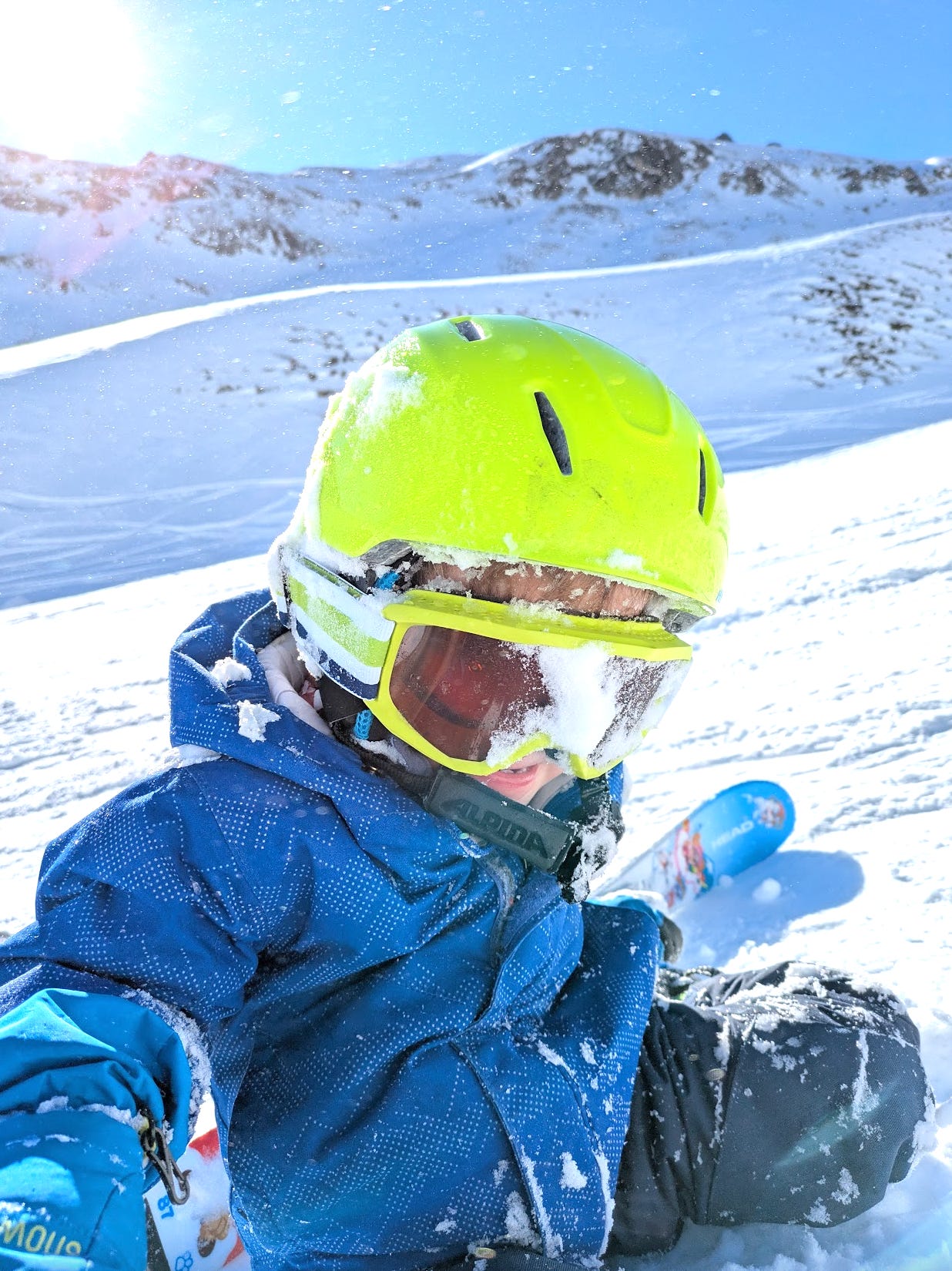
But on the second day, it just clicked for her, to the extent that I led her out of the baby slopes and into grown-up blue pistes. It’s been the same with other things my kids have learnt: writing, reading, board games, etc.
The problem is that many parents (and, unfortunately, schools) give up way too quickly. Those first few steps seem impossible to take, so many parents throw in the towel. I suggest you keep going; it gets exponentially (well, exponential-decayishly) easier.
If you liked this post, you might also like…
Our approach to the Santa question = answer questions with questions.
Do you think Santa exists?
How do you think he gets down the chimney?