
On seriousness

Here’s one of the best pop culture quotes in recent years:
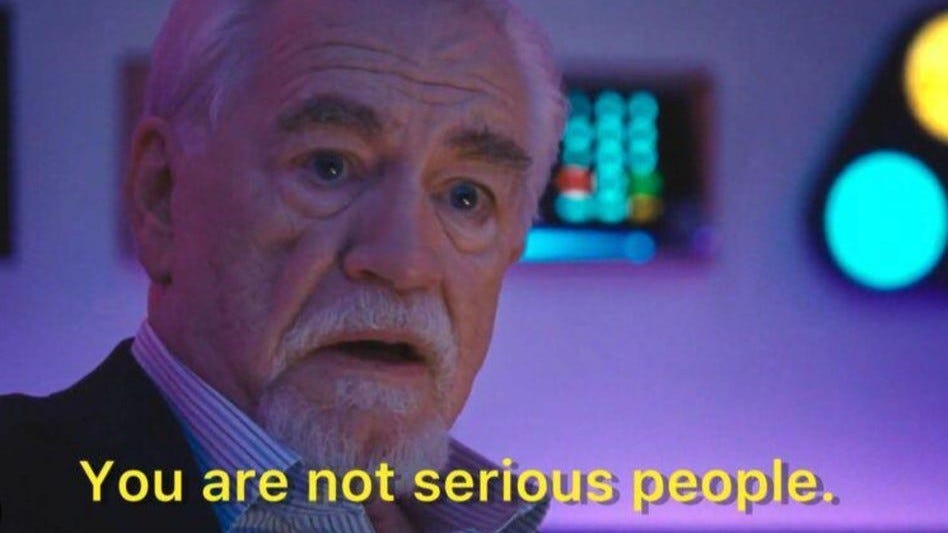
It has resonated with many of my friends and colleagues, who often send it as a GIF whenever they observe a lapse in seriousness.
But what does it mean to be serious? I’ve asked a few people, and they all gave a similarish answer; my brother’s was almost word-for-word identical to the one I had formulated myself: seriousness is treating situations with the solemnity, gravity, and consideration they require. Though this definition is quite satisfying at first glance, there are two issues with it. First, it’s more subjective than I’d like: who determines the appropriate level of gravity for a particular situation? Is it just a case of societal consensus? Granted, all judgements on behaviour will be subjective to an extent, but I think this is too much so. Second, it conflates seriousness with the appearance of seriousness (a fault of the English language. Greek has two different words for these two different notions). Who is more serious? A deeply pious but shabbily dressed church-goer, or someone in the correct attire who appears at mass because they treat it as a social occasion?
Let’s see whether we can do better by surveying a few examples of what I (and I think most people) would agree is not serious behaviour, and see if we can find a common thread.
In a personal context, it’s not serious to…
agonise (or pretend to agonise) over a decision you’ve already made in your mind
do what you think you should want, or what you want to want, instead of what you actually want
make decisions without questioning your motivations
In a professional context, it’s not serious to…
care more about adhering to a process, than trying to accomplish what the process was actually designed to do
spend a lot of effort on analysis to justify a decision that you’ve already made in your mind
knowingly make a wrong decision because you believe it’s what your superiors/peers want
knowingly waste time on things that don’t matter because it’s somehow expected in your organisation
constantly flip-flop on decisions without there being new data
use jargon
In politics, it’s not serious to…
oppose a policy because of who’s suggesting it, rather than because you disagree with it
knowingly make wrong decisions because of popular pressure
What all these have in common is doing things for the wrong reasons, but doing so knowingly rather than by mistake: they’re all cases of performative activity, and of elevating appearance above substance.
It’s true that a few of these examples (e.g. making decisions without questioning one’s motivations) are more akin to mistakes than deliberate pretence. And even in the most blatant cases of adhering to form rather than substance (e.g. ticking boxes vs producing results) people can delude themselves into thinking they’re doing the right thing for the right reasons. But I think these kinds of mistakes are so preventable with a little introspection, or so obvious when pointed out, that making them is unserious in a way that other kinds of mistakes — the ones we’d aptly call honest mistakes — are not.
In contrast then, seriousness means being earnest and diligent in understanding why you’re doing what you’re doing. Which does not mean you have to be dour; on the contrary, my own experience is that the least serious people are often also the most humourless.