

In the wake of Jacob Coxton’s resignation tweet, some people have responded by becoming terrified, some have called it marketing hype or doomer hysteria, and some have expressed incredulity: if AI labs really believe they are building something that has a 10% chance of causing extinction, they must be morally bankrupt.
I want to focus on this last one. I myself don’t think AI researchers are morally bankrupt; but I do think their modelling of the competitive dynamics at play is wrong. Most people describe the race to AI as a prisoner’s dilemma, the classic dynamic that results in rational agents choosing to not cooperate. Let’s imagine there are only two labs; if each lab thinks that it can develop AI without risk, but that the other lab is not as responsible, it makes sense to race to build: building always has a higher pay off than pausing, regardless of what the other lab does. In this scenario, carrying on building is not only not morally bankrupt, it’s the only sensible choice.
However, since labs agree that there is a significant risk of human extinction in their own effort to build ASI, the prisoner’s dilemma doesn’t hold: a better model is the Stag hunt. In this model, labs would rather both pause, but because they don’t trust each other, neither chooses to do so. This is why they’re calling for regulation and coordination, as a forcing mechanism. Even in this model, continuing to race is morally defensible: each lab thinks there is huge risk in doing so, but each believes that achieving ASI first is less risky than the other lab doing it.
But this model is still not good enough: it ignores that a lab that pauses building, and dedicates its full resources to AI safety instead, reduces the risk of a bad outcome even if the other lab carries on racing: after all, safety breakthroughs from lab A will be adopted by lab B. In this model, pausing is in fact a dominant strategy if three conditions hold:
The cost of extinction is far higher than the benefits of ASI.
AI safety research is transferrable, but not fully. If it were fully transferrable, it would boost each lab’s payoff in the scenario where it builds, therefore changing the expected payoffs in favour of building vs pausing.
Each lab thinks it’s safer than its rival, but not dramatically so.
All three of these are reasonable assumptions: extinction does outweigh ASI’s benefits (especially given that we can still expect massive benefits from non-S AI), AI research is transferrable, and it's unreasonable for any lab to think only they can build AI safely (it is legitimate to think they are more responsible than their competitors; but to think no-one else can possibly get it right is not just hubristic, it’s clearly untrue, given the number of researchers jumping from lab to lab).
I will get to the maths of this in a minute, but before I lose my non-technical audience, the upshot is this: if you work for Anthropic or OpenAI, the rational thing to do is to unilaterally pause, and focus exclusively on alignment research. This is the right thing to do even if you think you’re more responsible than your competitors, and even if they don’t pause — as long as you trust them to use your safety research. But in fact, the moment a lab pauses, its competitors will also be compelled to pause. And the nice thing here is you don’t need to worry about enforcement mechanisms, because, assuming researchers are being earnest, there will be immense pressure within a lab that hasn’t paused while its competitor has. Imagine if Anthropic announced it’s pausing; how would Sam Altman tell his own researchers to carry on racing? Wouldn’t they all quit, if they really are being honest about the risks they see?
There are two objections to preempt: first, worries about being accused of anti-competitive collusion. I’m not a lawyer, but I don’t see how a unilateral pause, without formal agreement, can be seen as collusion. But even if it were… let’s be real here, are AI labs claiming that the threat of a lawsuit looms scarier than human extinction? Really?
Second, China. This objection is not so easy to deal with, but first, China is still behind the race; labs can afford to pause at least for a little while. Second, again, one would expect Chinese labs to use any safety research coming out of the west, because why wouldn’t they? So, per game theory, pausing still makes sense. Third, once the big US labs have paused, coordinating a response to China becomes easier.
Right, onto the maths. It’s been year since I’ve studied game theory, so I had to rely on AI for what follows. The intuition and model is mine, the formalisation is Claude’s.
Imagine two labs, A and B, each with a choice to build or pause:

Now, define the following parameters:
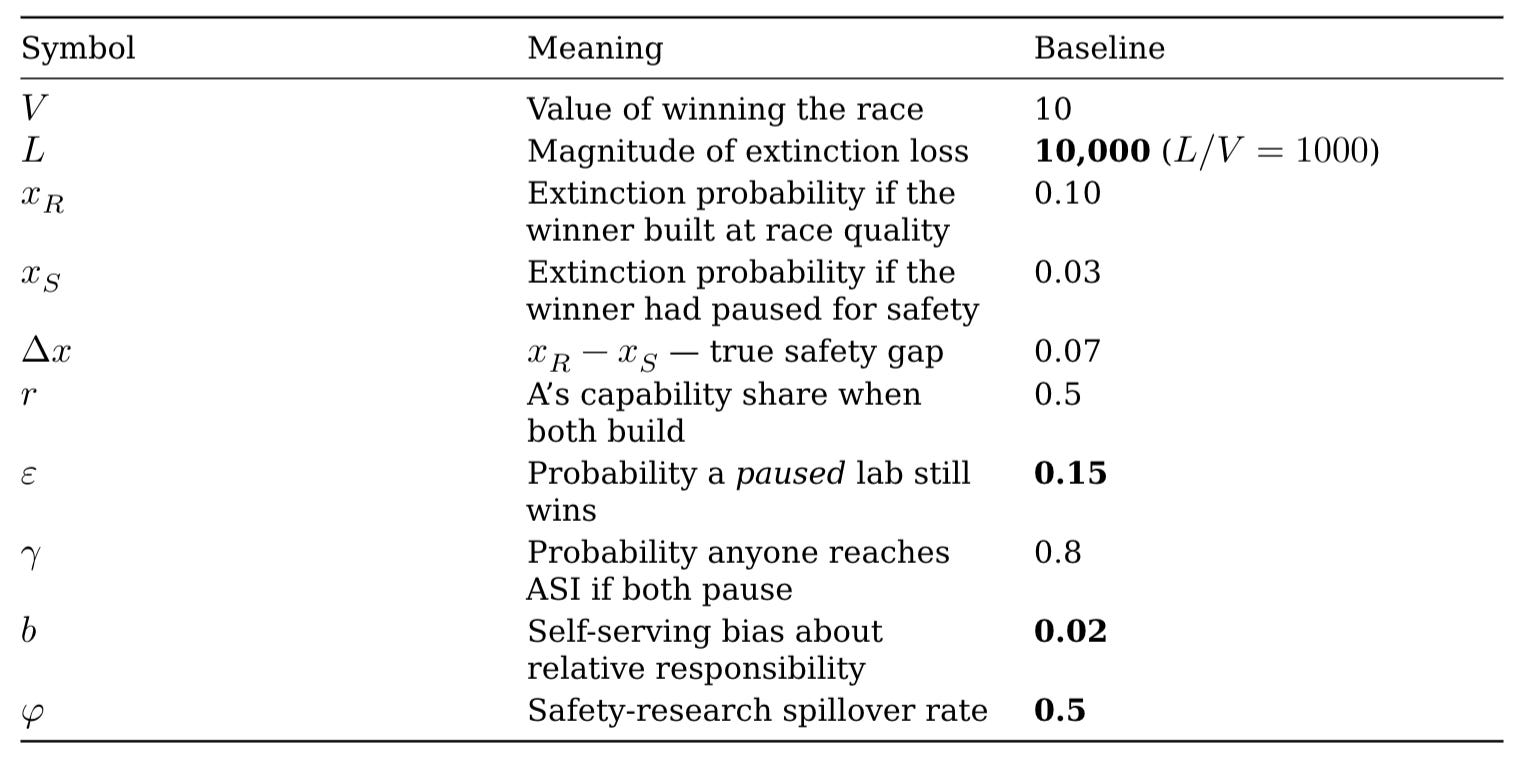
In plain English, the above base case assumes
ASI will eventually be reached, though if both labs pause, the probability of it happening drops to 80%
There is a 10% extinction risk, which can be brought down to 3% if labs stop racing and invest in safety instead
Some of the benefit of one lab pausing transfers to the other lab
Each lab is biased to think it’s more responsible than the other; in the baseline above, a bias of 0.02 means that lab A thinks its own risk if it builds is 10% - 2% = 8%; while its competitor’s is 12%.
Then, the extinction risk is:

Though each lab adjusts this by b. So each lab’s subjective estimate of extinction probability becomes

And the payoff function is

So finally, each lab needs to decide what to do depending on what the other lab might do:

And the values of D1 and D2 determine the structure of the game. If D1 and D2 are both positive, it means a lab is always better off building — i.e. a prisoner’s dilemma.
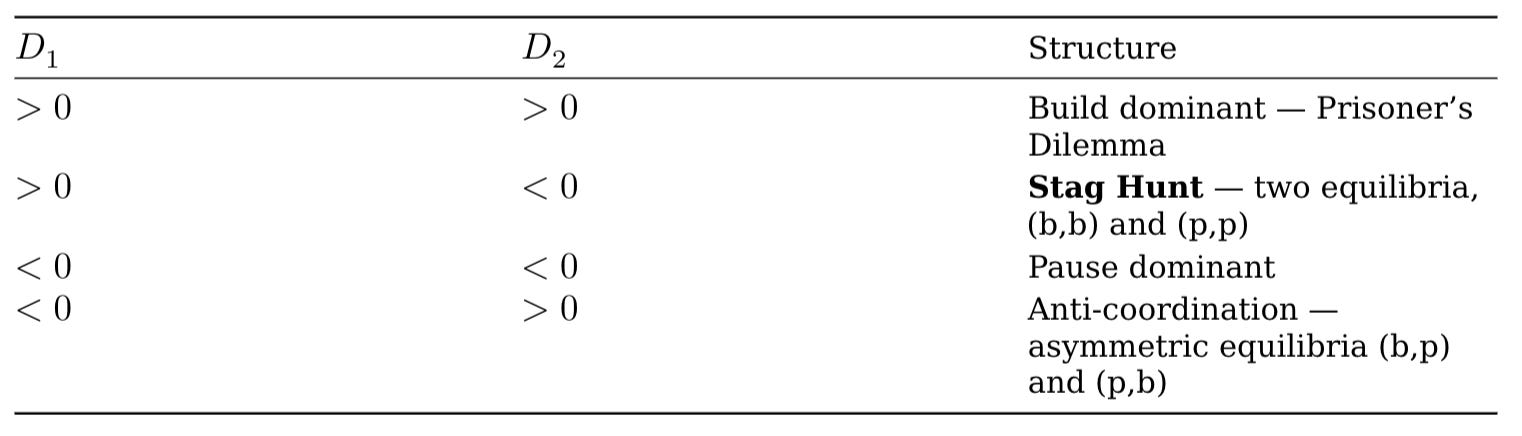
But if the conditions outlined above hold, we can plug in the baseline numbers, and then D1 and D2 are both negative — pausing is always the dominant strategy:

The question is, how robust is this result? How sensitive to our assumptions? It turns out quite a lot:
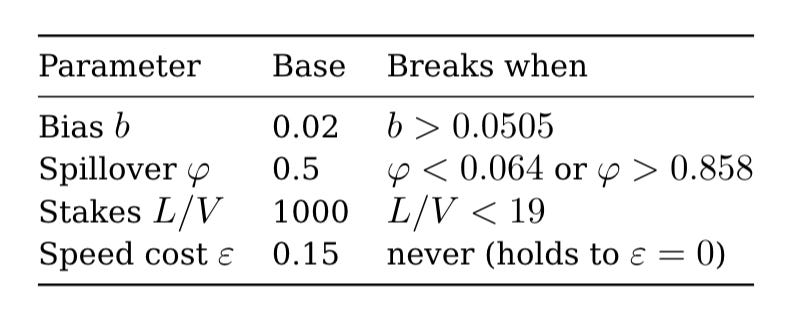
The only element of this that I think can be safely questioned is the bias factor: if a lab really thinks it’s much safer than its competitors, this turns back to a stag hunt. But consider what the breaking value of 5% means: it would suggest a lab thinks it alone can shrink the extinction risk from 10% to 5%, while its competitor will increase it from 10% to 15%. This does begin to look unreasonable.
As I said. I haven’t done game theory in a while. I would love to hear where this model breaks!
I liked this. I also think concerns about China racing may be overblown (at least relative to the risks of the labs themselves racing). It's not clear to me China, absent the US racing, has good incentives to race. Leadership in China appears fairly stable right now, and places a high value on control (at it appears that way to me). If you are stably in power, possess most of the infrastructure advantages (power grid, manufacturing) that will set you up well in a world with better (but aligned) AIs, and place a high premium on control, racing forward with AI development seems strickly negative. Sure in a best case you can dominate your ally. But in the worst case you've lost control and everyone is dead. Given a currently stable situation I think leadership rationally would assess not racing as having a higher expected payoff.